Price and Availability Consistency: Why Your Product Page, Schema and Feed Must Agree
Product DataLinqCheck Editorial Team· 8–9 min read
A product should not have three different versions of the truth.
Published:
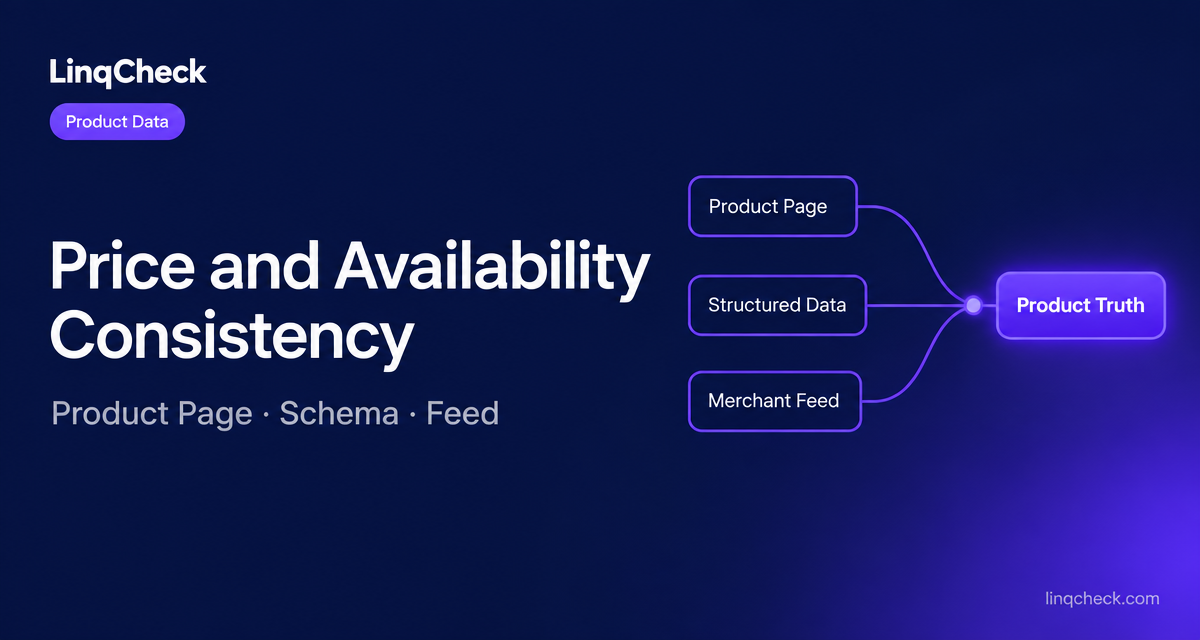
Yet this happens surprisingly easily in ecommerce. The product page says an item costs £79. The Offer structured data still says £99. The Merchant Center feed has already switched to £79 — but marks the product as out of stock while the page says it is available.
To a shopper, this looks confusing. To systems trying to understand, compare or surface the product, it creates an even more fundamental problem: which value should they trust?
Price and availability therefore need to be treated as product facts, not isolated fields maintained by separate teams or systems. The visible page, structured data and product feed are different representations of the same commercial reality. When one changes, the others need to follow.
That is a Product Truth problem.
One product fact can exist in several places
For many ecommerce teams, “the price” sounds like a single database value. In practice, a commerce stack can expose it through several surfaces.
A shopper sees a price and stock message on the product page. A crawler may also encounter a Product and Offer object in JSON-LD. Google Merchant Center receives a price and availability through a product data source. Checkout may expose yet another current value.
These surfaces have different technical purposes, but they are describing the same offer.
Google’s Merchant Center product data specification explicitly says that the submitted price should match the landing page, structured data and checkout. Its guidance for availability similarly requires the submitted stock status to agree with the product experience. Google also requires structured data to match values shown to customers.
This means a technically valid JSON-LD block is not enough.
If the markup parses correctly but contradicts the page, you have not created better product data. You have created another conflicting source.
Why price and availability are particularly fragile
Some product facts change rarely. A laptop's screen size or a chair's material may remain stable for the life of the SKU.
Price and availability are different.
A promotion begins. Inventory reaches zero. A returned unit becomes available. A sale expires at midnight. A variant sells out while the other sizes remain in stock. A regional price changes. The website updates immediately, while a scheduled feed refresh happens hours later.
The information may have been correct everywhere at 09:00 and contradictory by 09:05.
Google's current Merchant Listing documentation highlights this problem specifically. It recommends putting Product structured data in the initial HTML for merchants optimising for shopping results and warns that dynamically generated markup can make Shopping crawls less frequent and less reliable — a particular concern for fast-changing information such as product availability and price.
The operational lesson is more important than the implementation detail: freshness matters, but synchronised freshness matters more.
What a mismatch actually looks like
Consider an ecommerce retailer running a weekend promotion.
| Surface | Price | Availability |
|---|---|---|
| Visible product page | £79 | In stock |
| Product structured data | £99 | In stock |
| Merchant product data | £79 | Out of stock |
| Checkout | £79 | In stock |
None of these values is unusual on its own. The problem is that they describe incompatible versions of the same offer.
The £99 structured-data value might be yesterday's price. The feed's stock status might come from an inventory export generated before new stock arrived. The visible page and checkout may already be correct.
A team looking only at the rendered product page could therefore conclude that the product is fine.
A team looking only at schema validation could also conclude that the product is fine: the markup may be syntactically valid.
But the product as a whole is not fine because its facts do not agree.
Google's price-mismatch guidance specifically calls out out-of-sync feeds, structured-data mismatches and variant selection as common causes. For availability, it also warns about contradictions between landing pages, checkout, structured data and the product data source.
Structured data is not a second product database
Structured data works best when it expresses the facts already represented by the underlying product experience in a machine-readable format.
It should not become a parallel content layer where a different product reality is maintained.
For a straightforward purchasable product, an Offer may communicate fields such as price, priceCurrency and availability. Google can use Product and Offer markup for merchant listing experiences, including surfaces that display price and availability.
But adding those properties does not make an incorrect value true.
It also does not guarantee a particular search result, ranking or AI citation. Google explicitly says structured data is not required for its generative AI search features and that no special schema markup is needed for them. Structured data remains useful as part of a broader search and commerce implementation, including eligibility for supported rich-result experiences.
The practical priority should therefore be agreement before enrichment.
A smaller set of accurate, aligned product facts is more useful than an elaborate schema graph that disagrees with what customers can actually see and buy.
Variants turn small inconsistencies into identity problems
Price and availability become harder when a product has colour, size, capacity or other variants.
Imagine a trainer sold in five sizes. Size 42 is out of stock and size 43 costs the standard price. If the page loads size 43 while structured data or a feed record describes size 42, the issue is no longer merely “wrong availability”.
Two different offers are being treated as though they were the same product state.
Google's product-variant guidance recommends that each directly selectable variant can be reached with a distinct URL in relevant implementations, and that selecting the variant shows the corresponding image, price and availability.
For ecommerce teams, this makes product identity part of the consistency check.
Before asking whether the price matches, ask: the price of which exact variant?
A consistent £79 is still wrong if one system associates it with the blue 128 GB version and another associates it with the black 256 GB version.
Treat updates as one product event
The safest operating model is to stop thinking of page content, schema and feeds as three unrelated publishing jobs.
Treat a price or stock change as one product event that needs to propagate across every relevant representation.
A practical consistency review should ask:
- What is the current verified price and currency for this exact SKU or variant?
- What is its current availability?
- Does the visible product page show those values clearly?
- Does the page's
Product/Offerstructured data describe the same values? - Does the product data source or feed submit the same offer?
- Does checkout confirm the same purchasable state?
The goal is not merely to make every field present. It is to make every representation refer to the same verified product fact.
Do not use automatic updates as a substitute for clean source data
Google Merchant Center can use landing-page information and structured data to update certain product attributes automatically, including price and availability.
That can help reduce some mismatches. But Google explicitly notes that automatic item updates are not a replacement for regularly providing accurate product data.
This distinction matters.
A corrective mechanism can reduce the effect of stale data. It does not remove the underlying process problem that caused one system to become stale in the first place.
If a promotion repeatedly creates a six-hour discrepancy between the website and the feed, the long-term fix is not to become better at correcting mismatches after they occur. It is to redesign how the change propagates.
What Product Truth means in practice
Product Truth does not mean choosing one technical format and declaring it authoritative.
It means establishing a verified current fact and making sure every relevant output represents that fact consistently.
For price and availability, that means separating three questions:
Observation: What values are currently present on the page, in its machine-readable data and in downstream product data?
Decision: Which price and availability are actually correct for this product, market and variant?
Current fact: What should every consumer of that product information now receive?
That distinction is useful because contradictions are not always solved by copying one existing field over another. One of the values may itself be wrong.
Verification comes before propagation.
Where LinqCheck fits
LinqCheck starts with the product page.
It analyses product information to identify missing, conflicting or unclear facts and evaluates whether essential information — including price, currency and availability — is sufficiently clear for systems that need to understand and act on the product.
From there, teams can close information gaps with verified product facts and create channel-ready content rather than generating new copy from incomplete inputs.
LinqCheck is not a replacement for Merchant Center feed management, inventory infrastructure or real-time catalogue synchronisation. The broader operational task remains with the commerce stack.
Its role is to help teams find an important part of the problem earlier: does the product page itself present a coherent, usable version of the product truth?
That is a better starting point than assuming that because every system contains a price field, they must all contain the same price.
Consistency is a prerequisite, not a visibility guarantee
Clean product information can reduce ambiguity and support search, merchant and agentic systems that need to interpret an offer.
It cannot guarantee ranking, inclusion in a particular AI response or commercial performance.
Google itself makes the same distinction: meeting technical requirements does not guarantee crawling, indexing or serving, and structured data does not guarantee that a supported search feature will appear.
The useful target is therefore not “optimise the schema to make AI choose us”.
It is simpler and more durable:
Give customers and machines one coherent version of what the product is, what it costs and whether it can actually be bought.
If your product page, markup and product data disagree, start by finding the conflicting facts before adding more content.
LinqCheck can help you analyse a product page, identify missing or inconsistent information and turn verified corrections into channel-ready content.
Sources
- Google Search Central — Merchant listing (
Product,Offer) structured data
https://developers.google.com/search/docs/appearance/structured-data/merchant-listing - Google Search Central — Product variant structured data (
ProductGroup,Product)
https://developers.google.com/search/docs/appearance/structured-data/product-variants - Google Merchant Center Help — Product data specification
https://support.google.com/merchants/answer/7052112?hl=en - Google Merchant Center Help — How to fix: Inaccurate price status due to inconsistency between feed and landing page
https://support.google.com/merchants/answer/9773429?hl=en - Google Merchant Center Help — How to fix: Inaccurate availability status due to inconsistency between feed and landing page
https://support.google.com/merchants/answer/9773127?hl=en - Google Search Central — Optimizing your website for generative AI features on Google Search
https://developers.google.com/search/docs/fundamentals/ai-optimization-guide
Share this article
Check your product page for free
Paste a product URL and see missing fields, inconsistencies and prioritised fixes in a couple of minutes.